Introduction
In September of 2025, Solana (SOL-USD) crossed the $247 mark. Fast-forward five months you can buy the token for $90. A drop of 64%. An overall software free-fall and Crypto Winter have contributed to the downfall of this once high-flyer. If you have a year-long horizon, this could be a great buying opportunity if you can stomach the volatility.
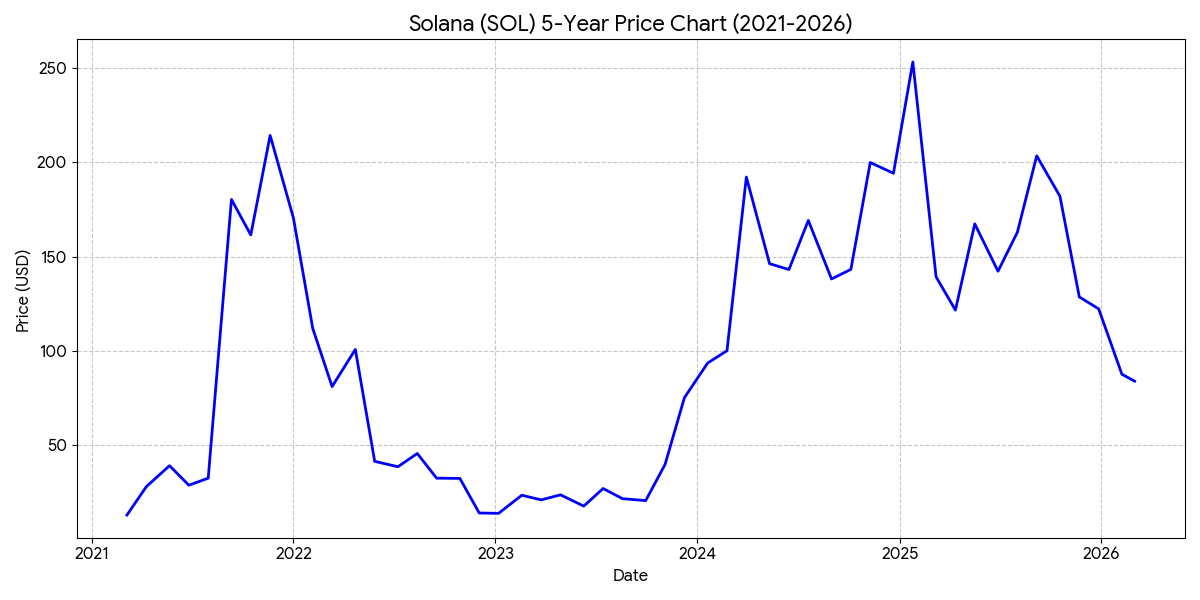
Solana Price History (Google Gemini)
Could it go lower? Absolutely, but it's tough to call a bottom, and if you're a crypto enthusiast or looking for growth, this could be an investment for you. Although Solana has a history of boom/bust cycles as demonstrated on the price chart, it has a humongous total addressable market [TAM] ahead over the next four years because of the tokenization of all things financial. This includes equities, derivatives, commodites and real estate. Depending on the source, tokenization of assets is projected to grow from $250 billion today to $4-16 trillion by 2030. Boston Consulting Group has the rosiest projection at $16 trillion. Citigroup (C) is much lower at $4-5 trillion. ARK Invest is between the two at $10 trillion. No matter who is correct in their projections, it's a tremendous opportunity to increase revenues for utility blockchains.
The Battle Royale
Currently, there's a big fight between the more established Ethereum (ETH-USD) and the newcomer Solana to capture the lion's share of tokenized assets flowing through their blockchains. Other players in the cryptosphere, such as Avalanche (AVAX-USD) and Cardano (ADA-USD), have promise but lag in market dominance. Although Cardano and Avalanche have outstanding growth rates, revenues are in the millions of dollars, not billions of dollars, as are Solana and Ethereum. Ethereum is the industry standard in DeFi, with 56% market share last year. Most of Solana's revenues are derived from the gaming, social media, and meme coins. Solana's market share in DeFi varies on the source, but a ballpark figure is approximately 12%. Clearly a distant number two to the leader, Ethereum.
| Blockchain | 2025 Revenue | 2026 Est. Revenue Growth | Key Growth Driver for 2026 |
| Solana | $2.39 Billion | 40% – 55% | Firedancer upgrade & Perp DEX expansion |
| Ethereum | $5 Billion | 15% – 25% | L2 Interoperability & Institutional RWAs |
| Avalanche | $207 Million | 30% – 45% | Real World Asset (RWA) Subnets |
| Cardano | $18 Million | 50% – 70% | Ouroboros Leios & Midnight Privacy Layer |
The utilitarian aspect of crypto is in a current period of consolidation. This is similar to the turn of the Twentieth Century, when there were over 100 automobile manufacturers, only to be dwindled down to a handful by 1920. This is happening now to crypto that actually does something.
A little background: Ethereum and Solana are programmable blockchains that enable users to "borrow, lend, trade, or earn interest on their cryptocurrency, all outside the traditional banks and financial intermediaries that comprise the TradFi [Traditional Finance] landscape," according to Anthony Saramucci in his new book, Solana Rising. Solana is considerably faster and less expensive than Ethereum. The knock on Ethereum has always been that it's slow, expensive, and doesn't process multiple transactions simultaneously. That's old news now. 2024's Dencun upgrade and 2025's Fusaka upgrade have made Ethereum much faster. In addition, Ethereum still remains the number two cryptocurrency in market cap at a whopping $238 billion. Almost five times larger than the upstart Solana, with a market cap of $50 billion.
Currently, it's a Coke (KO) and Pepsi (PEP) battle. Coke, like Ethereum, dominates in the global market in DeFi. Solana, like Pepsi, is the clear runner-up but has terrific products. With first-mover advantage and advanced security, Ethereum is favored by more established financial firms. Solana is competing with Ethereum in DeFi by focusing on lower fees, superior speed, and high-frequency trading capabilities. Solana is also attempting to be the "on-chain NASDAQ (NDAQ)", according to Scaramucci.
Why Solana?
A couple of years ago, Solana experienced network outages, which deterred large-scale financial institutions from utilizing the blockchain. That has been corrected. Plus, it was not as secure as Ethereum. This is also being corrected as developers flock to build the network. As reported in MEX.CO "As of early 2026, the competitive landscape between Solana and Ethereum has shifted from a theoretical debate to a data-driven rivalry. While Ethereum remains the "reserve currency" and institutional bedrock of DeFi, Solana has aggressively captured market share in terms of retail engagement, transaction volume, and capital efficiency."
When the above quote mentions "retail engagement", it is primarily referring to meme coins. A joke to many on Main Street, but no laughing matter to Solana. In 2025, trading and meme coin activity constituted about 50% of Solana's revenue. Web 3.0 and DeFi activity was 30%. Emerging verticles such as DePIN [Decentralized Physical Infrastructure] were less than 10%. Last year, Solana's total revenue was $2.85 billion.
| Metric | Solana | Ethereum |
| Current Price | ~$85.30 - $88.89 | ~$1,900 - $1,980 |
| Developer Activity | ~2,500 - 3,000+ active devs | ~5,000 - 6,000+ active devs |
| Monthly Revenue | $245 Million (Jan 2026) | $89 Million (Jan 2026) |
| Daily Active Addresses | ~2.17 Million | ~682,000 |
| Total Value Locked | ~$6.4 Billion | ~$52.4 Billion ($65B+ incl. L2s) |
| DEX Trading Volume | ~$108 Billion (last 30 days) | ~$63.7 Billion (last 30 days) |
Some notes on the table:
- It was generated using Google Gemini.
- DEX trading volume is the peer-to-pool mechanics of Automated Market Makers [AMMs], which allow users to exchange tokens with a wallet without an intermediary.
- According to Investopedia, "Total Value Locked in crypto measures the total USD value of assets deposited in decentralized finance [DeFi] protocols, such as lending, staking, and liquidity pools."
How To Invest in Solana
In the early days of crypto, the only way to invest was through a digital wallet on crypto exchanges such as Coinbase (COIN) and Binance. They can get hacked, tokens can get lost, and they are far from plug-and-play in terms of ease of use. Crypto purists prefer to use them. In the past few years, discount brokers such as Robinhood (HOOD) and Interactive Brokers (IBKR) introduced crypto trading on their exchanges. Not all discount brokers allow crypto trading, so check with whoever it is you invest with.
More recently, the way I prefer to play it is by using spot-priced ETFs. These ETFs have only been on the market for a few months and are very risky, just like buying cryptocurrencies in general. One caveat is that these ETFs are not registered under the Investment Act of 1940, and therefore are not subject to the same regulations and protections as 40 Act ETFs and mutual funds. Spot-priced crypto ETFs are regulated under the Securities Act of 1933, which means they are registered with the SEC and subject to anti-fraud provisions. You could lose everything, but if you're venturing into cryptocurrencies such as Bitcoin (BTC-USD), you probably are already aware of that. If the Clarity Act, which aims to regulate the digital asset market, passes in the Senate, then these ETFs should be much safer investments.
Here's a list of some of the many Solana spot-price ETFs:
- Grayscale Solana Staking ETF (GSOL), 0.35% expense ratio.
- Bitwise Solana Staking ETF (BSOL), 0.2% expense ratio.
- VanEck Solana ETF (VSOL), 0.3% expense ratio.
What About Ethereum?
Ethereum isn't going anywhere. It's the number two crypto in a universe of thousands of digital assets, right behind Bitcoin. Ethereum has the same Total Addressable Market as Solana to capture. Both should experience tremendous growth in the next five years. Neither Solana nor Ethereum are meme coins such as Dogecoin (DOGE-USD), Trump ($TRUMP-USD), or Bonk (BONK-USD). Although buying cryptocurrency can be considered gambling, I consider it an investment if you choose the right tokens. Solana and Ethereum are the plumbing for the infrastructure of WEB 3.0. In the not-so-distant future, both of these blockchains, along with crypto oracle Chainlink (LINK-USD), will be in the lexicon of Main Street investors. Investing in Ethereum utilizes the same methods as Solana, but has a different selection of spot-priced ETFs.
Conclusion
This is a heavyweight fight. Just like Muhammed Ali vs Joe Frazier back in the day. Not just a boxing match but a clash of cultures. The whole world is watching, too. Although Solana is gaining ground, the technologies could leapfrog each other in the next few years, if not months. Right now in the DeFi arena, Ethereum is in pole position, but there's room for both. Just look at what's happening in the Artificial Intelligence space with Open AI's ChatGPT, Anthropic's (ANTHRO) Claude, and Google's (GOOG) Gemini. They change leads by the day.
The global DeFi market is expected to grow at a Compound Annual Growth Rate [CAGR] of 21.8% to 68.2% in the coming years, with 2026 appearing as a key year of high growth. With a huge Total Addressable Market, this is a place you can make a lot of money, especially at these distressed prices. Solana has near-term momentum in the cryptosphere and is gaining market share. The Clarity Act is set to become law. Solana's price is under pressure. For 2026, Solana is projected to experience a 40%-55% revenue growth rate. Because of these factors, I believe that Solana is a good bet for the next year and beyond.

No comments:
Post a Comment